

Reading Fluency
Reading fluently means being able to read words accurately, smoothly, and with expression, so
it sounds like talking and helps you understand what you’re reading.
Fluency is the bridge between word reading (sounding out the words on the page) and comprehension (understanding what you read).
To support your child in becoming an increasingly automatic reader - in other words, reading the words on the page automatically - they need lots of repeated practice.
To help you understand what's happening for your child, think about when you first learned how to drive.
At First: Conscious Effort
Driving: When you're just starting out, you have to think carefully about every action: checking mirrors, signaling, pressing the pedals, steering, watching signs.
Reading: As a beginner reader, you sound out each word slowly, focus on phonics, and have to stop often to figure out meaning or pronunciation.
With Practice: Automaticity Develops
Driving: Over time, actions become second nature. You don’t think about each step. You just "drive." Your brain handles complex tasks (like reacting to traffic or navigating) without conscious effort.
Reading: With fluency, you stop sounding out each sound or word. You recognize words instantly, read smoothly, and comprehend as you go without pausing to think about each piece.
Higher-Level Thinking Becomes Possible
Driving: Once you're fluent, you can focus on strategy, such as anticipating other drivers' moves or choosing the best route.
Reading: When fluent, your brain focuses on understanding deeper meanings, drawing inferences, and connecting ideas (not just reading the words).

Stay connected with Melissa and Lori!
A 5-Day Reading Fluency Routine for Home
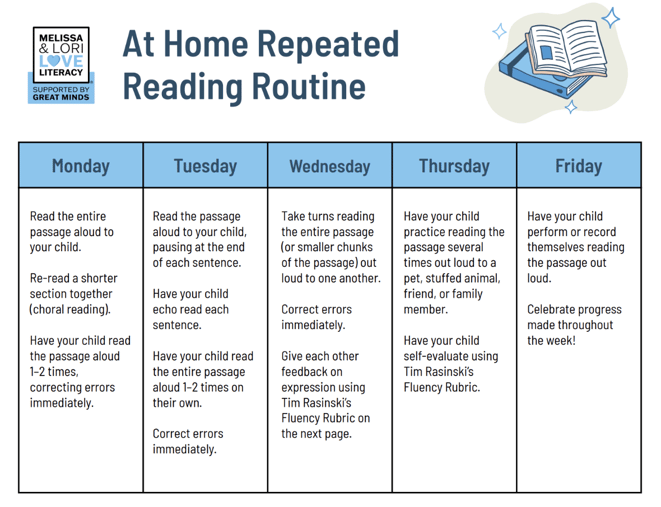
Building your child’s reading fluency takes just a little practice each day. Schedule 5-10 minutes each day to practice reading fluency. Read the same text over and over throughout the entire week.
Here’s a simple, five-day plan you can use at home to make reading practice effective and fun!
Stay connected with Melissa and Lori!
Day 1: Model & Choral Reading
Read the whole passage aloud to your child first so they hear a fluent reader read the passage aloud. This is called modeling. Then, choose a shorter section and read it together at the same time. This is called choral reading. Finally, have your child read the entire passage aloud 1–2 more times on their own. Correct mistakes right away to keep practice accurate.
Day 2: Echo Reading
Select a shorter section of the text. Read a sentence or part aloud, then have your child “echo” by reading it back to you. Be sure they are looking at the text when they echo read, not simply repeating what you read. Work through the entire passage this way. Afterward, have your child read the full passage 1–2 times on their own. Give immediate feedback on errors.
Day 3: Partner Reading
Take turns reading the passage aloud. You can switch off by sentence, paragraph, or even read the entire passage one after the other. Offer quick corrections and give each other feedback on expression using this Multidimensional Fluency Rubric.
Day 4: Independent Practice with an Audience
Have your child practice reading the passage out loud several times to a pet, stuffed animal, friend, or family member. Encourage them to rate their own reading using this Multidimensional Fluency Rubric to build self-awareness.
Day 5: Performance Day
On the final day, your child gets to perform! They can read the passage aloud to your family or record themselves. Celebrate their progress and the hard work they’ve put in all week.
Choosing the Right Passage for Practice
 When it comes to fluency practice, the passages you choose make a big difference! A great tip is to pick texts that connect to what your child is already learning in school. This helps reading practice feel more meaningful and reinforces important concepts.
For example, if your child is studying the rainforest in science, you might gather a few short passages about rainforest animals, plants, or ecosystems. Reading about the same topic across different texts builds background knowledge, strengthens vocabulary, and improves overall comprehension—all while giving your child extra practice with fluency.
Here are some excellent resources for finding passages:
- ReadWorks.org
This site offers a huge library of passages across grade levels and subjects, from fiction to nonfiction. You can easily find texts that match what your child is studying in school.
- TheBestClass.org
Packed with engaging Reader’s Theater scripts, this site makes fluency practice fun and interactive. Reader’s Theater allows kids to perform the text, which keeps them motivated and helps with expression.
- Just Two Teachers.com
Hover over the Readers Theater button and select a topic from the dropdown menu. You’ll find scripts that tie directly into subjects like science, social studies, and ELA . It's perfect for combining content learning with fluency practice.
One important note: Your child should always have clear access to the text, so make sure they can see the words as they read. Fluency practice isn’t just about speaking—it’s about connecting the sounds to the written words.
Try It

Building reading fluency doesn’t have to be overwhelming. A simple, consistent routine can make a big difference. Just like learning to drive, your child’s reading will move from slow and effortful to smooth and automatic with regular, focused practice. By setting aside just 5-10 minutes a day and choosing challenging but short texts, you’re giving your child the tools they need to become a skilled, fluent reader.
Citations
Loftus, M., & Sappington, L. (2024). The Literacy 50: A Q&A handbook for teachers: Real-world answers to questions about reading that keep you up at night. Scholastic Professional. https://www.amazon.com/dp/1546121862
Rasinski, T. (n.d.). Multidimensional fluency rubric: 4 factors [PDF]. Retrieved from https://www.timrasinski.com/presentations/multidimensional_fluency_rubric_4_factors.pdf
Melissa and Lori are literacy experts, authors of The Literacy 50, contributors to The Science of Reading in Practice, and co-hosts of the popular Melissa & Lori Love Literacy podcast. Lori shares insights on keynote appearances, session highlights, and professional updates on her website.
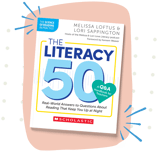
📘 To learn more about fluency, check out our book, The Literacy 50–A Q&A Handbook for Teachers: Real-World Answers to Questions About Reading That Keep You Up at Night.
Topics from this blog: Literacy reading comprehension fluency caregivers repeated parents home


