

Last year, we welcomed literacy Speech-Language Pathologist Linsey Jones on the podcast to discuss phonemic awareness intervention and the power of early, strategic support. In this guest post, Linsey shares compelling kindergarten data from her school, demonstrating how a proactive, systematic approach to phonemic awareness intervention can dramatically change students' literacy trajectories… not just in the moment, but for years to come.
If you'd like additional context before diving into Linsey's data and reflections, be sure to listen to our podcast conversation, where we explore the "why" behind her approach and the critical role of early intervention in preventing reading difficulties.
~Melissa & Lori
What Happens When We Intervene Early
Last year, I joined the Melissa & Lori Love Literacy Podcast to talk about phonemic awareness intervention and the power of early, strategic support. One of the biggest themes from that conversation was this:
Strategic intervention changes trajectories.
This year, for the second year in a row, we're seeing evidence that these outcomes can be replicated.
After analyzing my end-of-year kindergarten phonemic awareness data, one thing became incredibly clear: when intervention is targeted, systematic, and responsive to student need, students grow by leaps and bounds.
.jpg?width=400&height=518&name=Copy%20of%20Effective%20Interventions%20-%20Literacy%2050%20(1).jpg)

Stay connected with Melissa and Lori!

Strategic Intervention Changes Literacy Trajectories
According to this year's kindergarten data, students who participated in the intervention program demonstrated substantial gains in phonemic awareness skills across the school year.
My intervention students started the year well behind their peers in phonemic awareness. The intervention group averaged just 8 points on the baseline assessment, compared to 26 points for students who did not receive intervention. With proficiency set at 34 out of 42 possible points, they had a significant gap to close. By year's end, they had done exactly that.
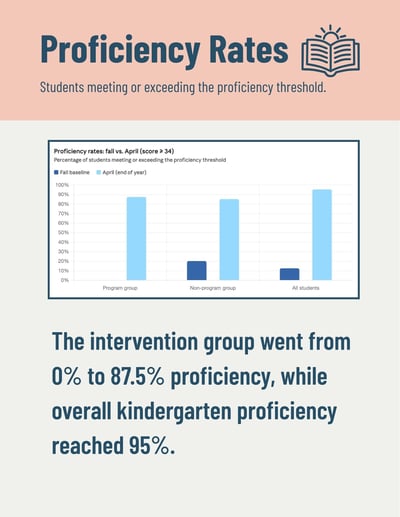
But the most meaningful takeaway isn't just the averages. It's the outcomes across the entire kindergarten population.
By the end of the year:
- 95% of kindergarten students were mastering phonemic awareness skills.
- 3% were nearing proficiency.
- 2% remained below proficiency benchmarks.
Phonemic awareness is not just another kindergarten skill. It is one of the strongest predictors of future reading success. When students struggle to segment, blend, and manipulate sounds early on, the effects often ripple into decoding, fluency, spelling, and comprehension later.
One of the things I'm most proud of is that this year's data mirrors what we saw last year. Replication matters. Anyone can have a "good year." But when strong outcomes begin repeating across cohorts, it suggests the system itself is working.
What Drove These Results? A Deliberate System of Support
What makes these outcomes especially important is that they they came from a deliberate system of:
- Early identification
- Strategic grouping
- Explicit instruction
- Cumulative practice
- Responsive intervention
- Progress monitoring that informed instruction
You can see the full process in this infographic.
This work also reinforced something I deeply believe: intervention should not feel disconnected from core instruction.
.jpg?width=400&height=400&name=Paperclip%20Quote%20Varieties%20(2).jpg)
The strongest growth happened when classroom instruction and intervention worked together: when students received consistent language, consistent routines, and consistent instructional priorities across settings.
Phonemic awareness instruction does not need to be flashy to be powerful. It needs to be:
- Explicit
- Systematic
- Responsive
- Strategically sequenced
That's what reshapes outcomes.
The Bigger Story: Why Early Intervention Matters
Too often, intervention is viewed as something reactive, something we do after students fall behind. But strategic intervention changes that narrative. When we intervene early and precisely, we can dramatically alter literacy outcomes before students experience long-term reading difficulty.
The reality is that many kindergarten students are capable of far more growth than we sometimes expect, especially when instruction is aligned to the science of reading and delivered with intensity and purpose.
We watched the kindergarteners from last year, who are now first graders. Not only did they maintain their skills, they are on their way to becoming readers.
- CVC patterns? Check!
- Blends and digraphs? Check!
- vCe? Check!
- R-controlled vowels? Check!
- Vowel teams? Check!
Those early gains became the foundation for continued reading success.
The Real Story Behind the Data
That's why I'm so passionate about proactive intervention. When we identify needs early and respond with intentional, evidence-based instruction, we're able to change what's possible for students as readers before they ever experience significant reading difficulty.
The data are encouraging, but the real story is the students behind the numbers. It's the kindergartener who enters school at risk and leaves with a strong foundation. It's the first grader who continues building on those skills and sees themselves as a reader. It's the reminder that when we provide the right support at the right time, growth is possible.
That's what keeps me motivated to continue refining this work, learning from these patterns, and helping more educators build intervention systems that don't just improve outcomes for a single year, but change literacy trajectories for years to come.
Our friend & guest blogger Linsey Jones is a Speech-Language Pathologist specializing in early literacy development and has a particular interest in preventative, rather than reactive, intervention models. Learn more about Linsey here.
Topics from this blog: Literacy reading phonics systematic phonemic awareness speech language


